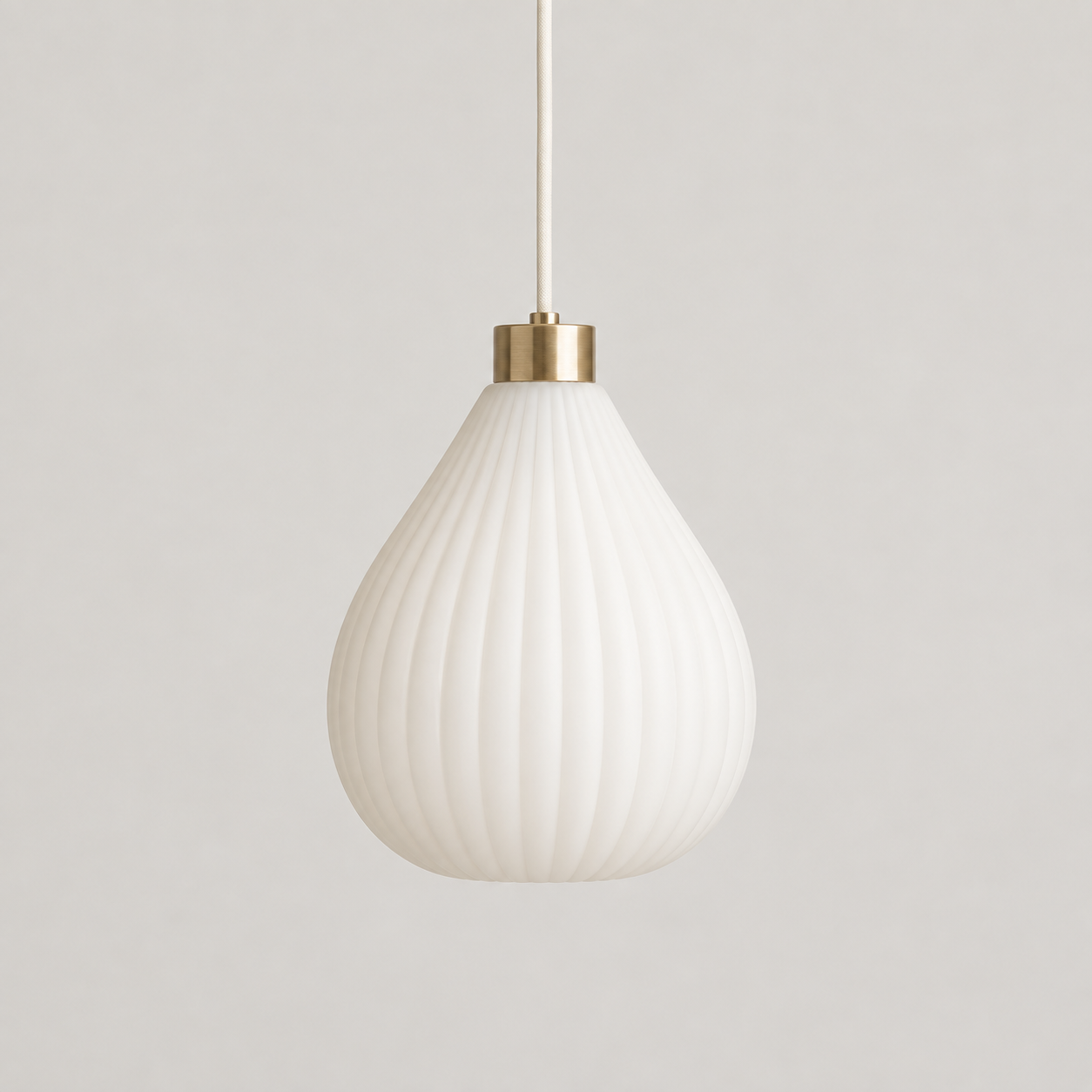
Opal Ripple
Opal / brushed brass
THE DETAILS
Colour temperature and brightness describe different things. Understanding the labels makes shopping much easier.
Colour temperature, shown in kelvin, describes the appearance of white light. Within this catalogue, 2700 K integrated fittings have a warm tone and 3000 K fittings have a slightly crisper warm-white tone. Both can feel comfortable; the room and materials around them influence the result.
For products marked bulb dependent, the fitting does not determine the colour temperature. Your chosen bulb does. Keep that distinction in mind when comparing an integrated LED ring with a lamp that accepts a replaceable bulb.
Lumens describe light output. Watts describe power consumption, so two different LED products with similar wattages do not necessarily produce the same useful light in a room.
The shade also matters. An opaque dome directs light downwards; a fabric shade or opal globe diffuses it. Use the published lumen figure where one is available, and avoid guessing an output for a bulb that has not been selected.
LUME’s example collection includes E27, E14, GU10 and G9 lamp holders, plus integrated LEDs. These are not interchangeable. Check the holder, the available physical space and the maximum LED power on the specification sheet.
A dimmable bulb, a compatible fitting and a suitable dimmer need to work together. Some lights here are explicitly non-dimmable. Ask your electrician or supplier to confirm compatibility rather than assuming a new light will work with an old dimmer.
Product examples refer to the fictional LUME collection. Confirm specifications and installation requirements with a qualified professional for a real project.
CONTINUE EXPLORING
Meet Norby, your personal lighting guide.